




















Key takeaways
The Agile Manifesto has reshaped the modern team’s approach to software development. It is often referenced in certification docs and every development framework you’ll encounter, from Scrum to Kanban. But as AI, remote teams, and enterprise workflows reshape how we build software, it’s worth knowing how it remains relevant in guiding project teams. In this article, I’ll walk you through what the Agile Manifesto is about and why its values and principles still apply today.
What is the Agile Manifesto?
The Agile Manifesto is a foundational document that outlines the values and principles of Agile software development in response to the traditional approach that involves excessive planning and documentation.
Before Agile, most teams followed the Waterfall method, worked through long phases, and planning took months. By the time the software was released, requirements had changed, and the product no longer met user needs. The Manifesto challenged this model by introducing a more efficient framework that emphasizes continuous improvement.
The history behind the Agile Manifesto
The Agile Manifesto emerged from growing frustration with how software was developed in the late 1990s. Many teams were stuck in slow and process-heavy methods where they spent months planning before writing a single line of code.

In 2001, a group of 17 developers from different tech backgrounds gathered in Snowbird, Utah. With a shared goal, they discussed better ways to make software development more efficient. Instead of creating a new methodology, they focused on defining a shared set of values and principles to guide teams across different approaches and documented it as the Agile Manifesto.
The four core values of the Agile Manifesto
The authors of the Manifesto believed that placing too much emphasis on certain components made development teams less able to deliver working solutions for their customers. All these factors are important, but the items they value more will help satisfy customers.
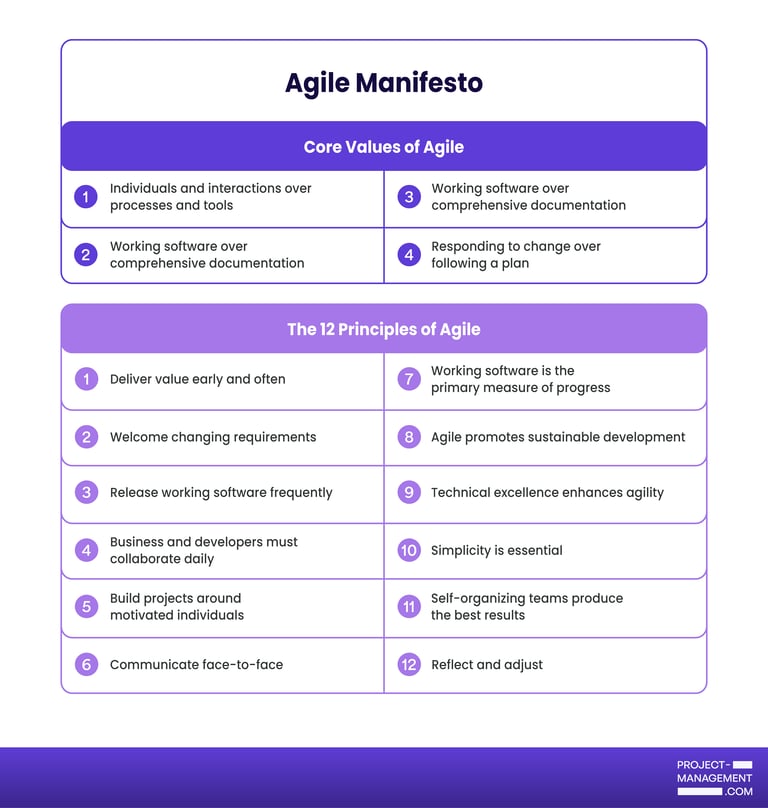
1. Individuals and interactions over processes and tools
Tools and processes exist to help people work better, but good software relies on strong communication and teamwork. When a process gets in the way of good communication or sound judgment, the people should take precedence.
2. Working software over comprehensive documentation
The main goal of software development is to deliver something that actually works. While writing about the product supports the process, it should not slow down delivery.
3. Customer collaboration over contract negotiation
While contracts help set expectations, maintaining regular communication with customers encourages ongoing input. Frequent feedback helps ensure the product continues to meet user needs as they evolve.
4. Responding to change over following a plan
Accepting change as part of the process helps teams adjust their approach as requirements or priorities change. This flexibility helps them deliver software based on new information and current expectations.
The 12 principles of the Agile Manifesto
Built on the four values of the Agile Manifesto are twelve supporting principles:
1. Deliver value early and often: The highest priority is satisfying the customer through early and continuous delivery of working software. Ship something useful, then keep improving it based on feedback.
2. Welcome changing requirements: Even late in development, Agile welcomes changing requirements. Flexibility is a competitive advantage, and teams that adapt quickly are better positioned to deliver what customers actually need.
3. Release working software frequently: Aim to release working software in short cycles, weeks rather than months. The shorter the cycle, the faster you learn what’s working and what needs to change.
4. Business people and developers must collaborate daily: The people building the product and the people who understand the business need to communicate regularly. Frequent interaction keeps everyone focused on shared goals and priorities.
5. Build projects around motivated individuals: Give people the support and trust they need, then let them do their work. Giving teams autonomy and ownership encourages creativity and freedom to innovate.
6. Communicate face-to-face: Communication is the most effective way to share information within a team. Written updates have their place, but they’re no substitute for a real-time discussion.
7. Working software is the primary measure of progress: Progress is best measured by working software, not by completed tasks or documentation. This keeps teams focused on delivering usable features that customers can actually test and use.
8. Agile promotes sustainable development: Consistent work produces better results than pushing hard to meet every deadline. Agile encourages a pace that teams can maintain over time without burning out.
9. Technical excellence enhances agility: Good design and excellent coding make it easier to adapt as requirements change. Teams that cut corners tend to slow down over time as those shortcuts accumulate.
10. Simplicity is essential: Build what’s needed for now. Focusing on what is necessary makes work easier to manage and prevents adding features that do not contribute to the end goal.
11. Self-organizing teams produce the best outcomes: Allowing teams to manage work on their own gives them more room to find better solutions and innovate.
12. Reflect and adjust: Regularly reviewing team performance helps you identify issues and opportunities to improve. Strong Agile teams reflect on their work to eliminate ineffective practices and build better skills.
Agile Manifesto vs. Waterfall: Key differences
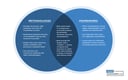
Agile and Waterfall represent two very different approaches to managing projects. Agile takes a more flexible approach by delivering work in short cycles and adapting as requirements evolve. Waterfall, on the other hand, follows a linear path, and each phase must be completed before the next begins.
Below is a table that highlights the key differences:
| Area | Waterfall | Agile |
|---|---|---|
| Planning | Defined upfront in full detail | Done incrementally as work progresses |
| Requirements | Fixed at the start | Expected to evolve over time |
| Delivery | Single delivery at the end | Frequent, incremental releases |
| Customer involvement | Mainly at the beginning and end | Continuous throughout the process |
| Response to change | Difficult and costly to accommodate | Welcomed and built into the process |
| Team structure | Hierarchical with defined roles | Collaborative and self-organizing |
| Risk management | Risks identified early but addressed late | Risks surfaced and addressed continuously |
| Best suited for | Projects with fixed requirements | Projects where requirements are likely to change |
How the Agile frameworks use the Manifesto
The Agile Manifesto has become the foundation for modern Agile practices. It shaped frameworks like Scrum, Kanban, and Extreme Programming, transforming how teams across industries approach complex work.
1. Scrum
Scrum organizes work into short cycles called sprints, typically two to four weeks long. Teams hold regular ceremonies, including daily standups, sprint planning, and sprint retrospectives, to coordinate and identify issues. It reflects the Manifesto’s emphasis on frequent delivery, collaboration, and continuous improvement.
2. Kanban
Kanban manages work by making it visible on a board, where tasks move through stages, from to-do to done. Rather than working in fixed sprints, teams pull new tasks only when they have capacity. This approach reflects the Manifesto’s principle of maintaining a sustainable pace while delivering value continuously.
3. Extreme Programming (XP)
XP centers on technical discipline and close customer involvement. Practices like test-driven development, pair programming, and continuous integration keep feedback loops short and ensure code excellence. It is one of the most direct expressions of the Manifesto’s commitment to working software and responding to change.
4. SAFe (Scaled Agile Framework)
SAFe applies Agile principles across large organizations where multiple teams work toward shared goals. It introduces planning structures and delivery cadences that help teams coordinate without losing autonomy. While more prescriptive than other frameworks, it remains grounded in the Manifesto’s values of collaboration, flexibility, and customer focus.
5. LeSS (Large-Scale Scrum)
LeSS extends Scrum to organizations with multiple teams working on the same product. It uses a simple structure and encourages teams to collaborate closely rather than operate in silos and add layers of process. LeSS preserves the Manifesto’s principles of transparency and preference for people and interaction over process overhead.
6. DSDM (Dynamic Systems Development Method)
DSDM was developed before the Manifesto but shares much of its philosophy. It has a fixed time and budget, then adjusts the scope rather than trying to deliver everything as originally planned. This keeps delivery predictable while staying true to the Manifesto’s focus on working solutions and active stakeholder involvement.
7. Crystal
Crystal is a family of methods that adapts its practices based on team size and project risk, rather than applying a one-size-fits-all process. Smaller or lower-risk projects follow a lighter approach, while larger or more complex ones require more structure. This flexibility reflects the Manifesto’s belief that the right process depends on the people and context involved.
8. Feature-Driven Development (FDD)
FDD organizes work around designing and delivering specific product features in short cycles. Each effort connects directly to a specific product outcome, and teams are focused on the results rather than process steps. It applies the Manifesto’s emphasis on working software by treating each feature as a deliverable unit of value.
How to apply the Agile Manifesto to your team
Following the Agile Manifesto means changing how you run meetings, handle feedback, and respond to shifting priorities. While this may seem straightforward, teams often treat it as a fixed set of rules instead of a decision-making framework.
Below are specific ways to apply the Agile Manifesto, from planning work to handling changes.
- Familiarize yourself with the values first: Before selecting a framework, discuss what the core values mean in the context of your team’s work. Teams that understand the purpose behind Agile practices apply them more effectively than those that follow them without context.
- Shorten your delivery cycles: If your team delivers work in large batches, try breaking it into smaller increments. Delivering something every two to four weeks gives you more opportunities to gather feedback and reduce the time between doing the work and learning whether it’s working.
- Involve stakeholders regularly: Involve stakeholders at key points so their feedback can shape what gets built. This doesn’t require formal reviews every week, but it does require regular check-ins before final delivery.
- Hold regular retrospectives: Set aside time at the end of each cycle to review what worked and what needs to improve. Focus on one or two improvements rather than a long list of observations that never get addressed.
- Update plans when needed: Update your plan when priorities change or new information comes in. This can be difficult in environments where changing direction is seen as poor planning, but Agile treats plans as flexible. A plan created at the start is based on limited information, so it should evolve as the team learns more.
- Protect team focus: Limit how much work your team handles at once. Too many competing priorities affect quality and slow down progress. Give the team space to focus on completing actual work.
- Measure progress by delivered work: Evaluate progress based on completed output that has been reviewed or tested. Tracking hours logged or tasks completed tells you how busy the team is, but says little about whether the work is progressing.
Applying the Agile Manifesto to your workflows requires a specialized tool to organize tasks and support change as they happen. Project management software provides a shared space to plan iterations, manage backlogs, track progress, and run retrospectives. Through intuitive project views, users can see what is being worked on and what has been delivered, which makes it easier to adjust priorities.
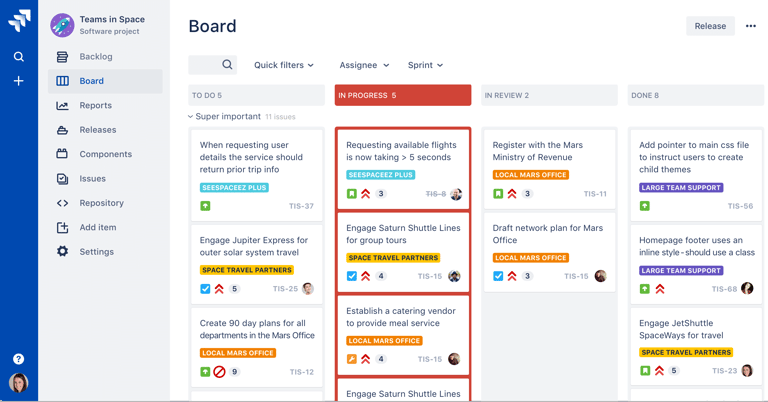
Jira, developed by Atlassian, is one of the most widely used platforms for Agile teams. It supports Scrum and Kanban workflows for planning sprints and tracking work as it moves through each stage. Reporting features like burndown charts and velocity tracking allow teams to measure delivery patterns over time. Jira also integrates with a wide range of development and communication tools, making collaboration easier without switching between multiple systems.
Agile Manifesto vs. common misconceptions
The Agile Manifesto is often misunderstood, especially by teams that adopt Agile practices without understanding the intent behind its values. Many assume it works only for dev teams and promotes little documentation or no planning at all. The table below breaks down the most common misinterpretations and what the Manifesto actually says.
| Agile Manifesto | Common misconception | What it actually means |
|---|---|---|
| Individuals and interactions over processes and tools | Processes and tools don’t matter | People should drive the work, but processes and tools still play a supporting role. |
| Working software over comprehensive documentation | Documentation is unnecessary | Write documentation that serves the work, and skip what doesn’t. |
| Customer collaboration over contract negotiation | Contracts are irrelevant | Contracts set boundaries, but ongoing collaboration matters more than defaulting to what was written at the start. |
| Responding to change over following a plan | Planning is a waste of time | Plans are necessary, but they should be updated as the team learns more. |
Is the Agile Manifesto still relevant today?
The Manifesto has faced its share of criticism, particularly as AI changes how software gets built. Steve Jones, Executive VP at Capgemini, sparked debate by arguing that AI-driven development contradicts the Manifesto’s human-centric values. When AI can build working apps in hours, principles around week-long development cycles by human teams start to show their limits.
But the counterargument is worth taking seriously. Rolf Läderach, an Agile coach at Sandvik, argued that Agile is about building adaptive organizations that can respond to change and deliver outcomes, and that need doesn’t disappear with AI. In fact, faster development cycles increase the need for clear direction and continuous adjustment.
The Manifesto’s specific practices may need updating for AI-driven environments, but the core values still hold. Teams still need to prioritize people, collaborate closely with users, deliver frequently, and adapt to change. If anything, they become harder to ignore when the development pace increases, and the cost of building the wrong thing is even higher.
FAQs
What is the difference between Agile values and Agile principles?
The four values define Agile priorities, such as people over processes and adaptability over rigid plans. The twelve principles support those values by offering more specific guidance on how to work. Think of values as the “why” behind Agile and principles as the “how.”
Does the Agile Manifesto apply outside of software development?
Yes, though it was written with software development in mind. The underlying ideas, specifically delivering work incrementally, being responsive to change, and communicating frequently, translate well to marketing, product design, operations, and other fields. The applications may look different, but the values apply across contexts.
What is the most commonly misunderstood part of the Agile Manifesto?
Most teams misread the four values as absolutes. Saying working software matters more than documentation doesn’t mean documentation should be skipped entirely. Each value acknowledges both sides and simply tells you which one to prioritize when the two come into conflict.